

What is Project Management? You may have heard this term many times, especially if you are exploring careers in construction, real estate, interior design, or even IT. But let’s break it down simply and practically.
Imagine you need to complete an office interior fit-out in just three months. You have a fixed budget, multiple contractors, design changes, and strict deadlines. Without a proper plan, the project can quickly become chaotic. Costs may increase, timelines may slip, and quality may suffer. This is exactly where project management steps in.
Project management helps you bring structure to chaos. It allows you to plan every step, manage resources efficiently, track progress, and deliver results on time. Whether you are building a commercial space, managing a construction site, or executing an interior project, you need a clear system to guide your work.
In today’s fast-moving and competitive environment, companies no longer rely on guesswork. They rely on structured project planning, scheduling, and execution. That is why project management has become one of the most important and trending skills across industries.
Here, you will learn what project management really means, how different approaches work, and how you can apply it in real-life projects like interior fit-outs. You will also explore certifications, tools, and skills that can help you build a successful career in this field.
Estimated reading time: 11 minutes
What is Project Management?
Project Management is the process of planning, organizing, executing, and controlling a project to achieve a specific goal within a defined time, cost, and quality. You start a project with a clear objective, follow a structured plan, and complete it within constraints.
A project is always temporary. It has a start and an end. For example, constructing an office space, completing an interior fit-out, or developing a software application are all projects. Each project delivers a unique outcome.
Project management focuses on three key factors—time, cost, and quality. These are known as the triple constraints. If you delay a project, costs increase. If you reduce the budget, quality may suffer. A project manager balances these factors to achieve the best result.
You also use project management to:
- Allocate resources efficiently
- Track progress through schedules
- Manage risks and uncertainties
- Communicate with stakeholders
In today’s fast-paced environment, companies prefer professionals who understand project planning, scheduling, and execution. This makes project management a highly valuable skill.
Project Management Approaches
Not all projects follow the same method. You choose an approach based on the type of project, level of uncertainty, and client requirements. The three most common approaches are predictive, adaptive, and hybrid project management.
Predictive Project Management
Predictive project management follows a structured and detailed plan. You define the scope, timeline, and cost at the beginning and execute the project accordingly. This approach works best when requirements are clear and unlikely to change.
In construction projects, teams commonly use predictive methods. For example, in a commercial building project, you prepare drawings, BOQ, schedules, and cost estimates before starting work. You then follow this plan step by step.
This approach gives you better control over cost and schedule. However, it offers limited flexibility. If the client requests changes during execution, managing those changes becomes difficult and may lead to delays or cost overruns.
Adaptive Project Management
Adaptive project management focuses on flexibility and continuous improvement. Teams adjust the plan based on feedback and changing requirements. This approach works well in projects where uncertainty is high.
Software development teams widely use adaptive methods like Agile. They divide the project into smaller parts and deliver them in phases. After each phase, they review feedback and improve the product.
Adaptive project management improves customer satisfaction because it allows changes during execution. However, it becomes difficult to predict timelines and budgets accurately.
Hybrid Project Management
Hybrid project management combines predictive and adaptive approaches. It gives you the structure of planning and the flexibility to handle changes.
In real-world projects, especially in interior fit-outs and real estate, hybrid methods work best. For example, in an office interior project, civil work and structural modifications follow a fixed plan. At the same time, design changes, furniture selection, and client preferences require flexibility.
Hybrid project management helps you manage complexity, reduce risks, and improve efficiency. That is why many modern projects use this approach.
Project Management Application (Interior Fit-Out Example)

To understand project management better, let’s look at a practical example of an interior fit-out project. This is highly relevant if you are working in construction or interior execution.
You start the project by defining the scope. For example, you may need to design and execute a corporate office within a budget of ₹50 lakhs and a timeline of three months. At this stage, you identify stakeholders such as the client, contractor, designer, and vendors.
Next, you move to the planning phase. You create a Work Breakdown Structure (WBS) to divide the project into smaller tasks. You prepare a baseline schedule using bar charts and define timelines for each activity. You also estimate costs, plan resources, and identify risks. For example, delays in material delivery or changes in design can impact the project.
During execution, you start actual work on-site. This includes civil work, electrical installations, HVAC systems, flooring, and furniture installation. You coordinate with contractors and ensure work follows the schedule.
At the same time, you monitor progress continuously. You compare actual progress with the baseline schedule. You prepare reports like Daily Progress Reports (DPR), Weekly Progress Reports (WPR), and Monthly Progress Reports (MPR). If you identify delays, you take corrective actions such as increasing manpower or rescheduling tasks.
Finally, you complete the project and hand it over to the client. You check quality, finalize billing, and close all documentation. This structured process ensures that you deliver the project on time, within budget, and as per client expectations.
Best Project Management Certifications
If you want to build a strong career in project management, certifications can give you a competitive edge. They validate your knowledge and improve your chances of getting better job opportunities.
The Project Management Institute offers some of the most recognized certifications in the world.
Certified Associate in Project Management (CAPM)
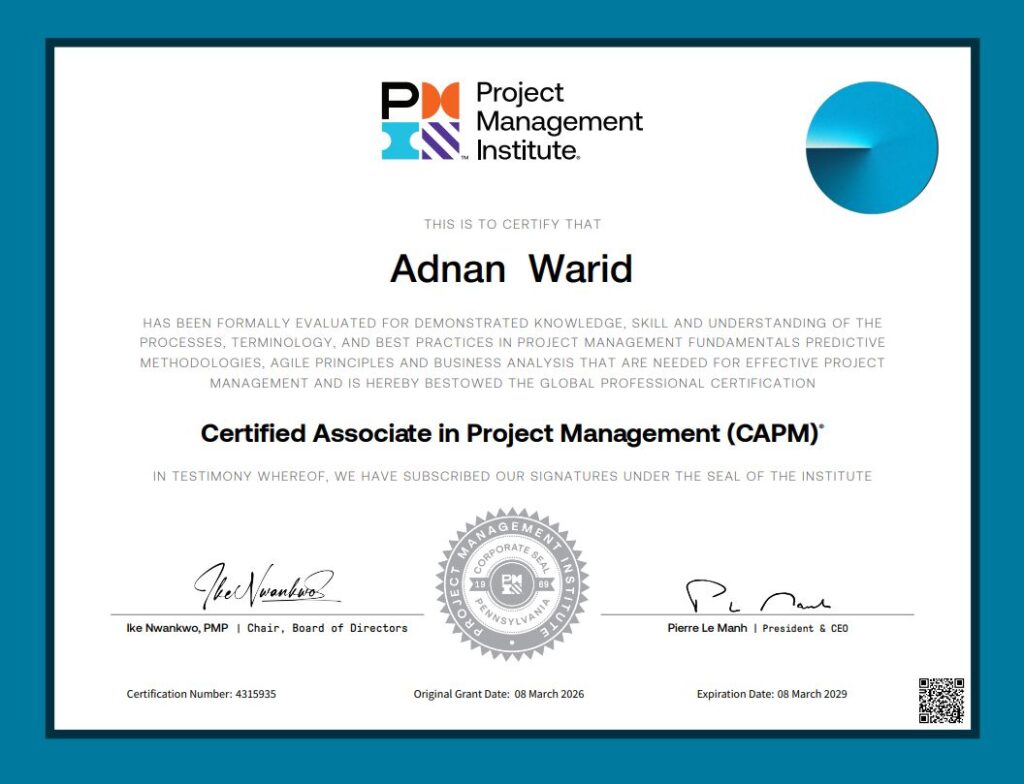
The Certified Associate in Project Management (CAPM), offered by the Project Management Institute, is one of the best entry-level certifications for aspiring project managers. It is designed for students, fresh graduates, and early-career professionals who want to build a strong foundation in project management.
CAPM focuses on core concepts such as the project lifecycle, project planning, scheduling, cost management, and risk management. It also introduces you to standard terminology and frameworks used globally in the project management field. This certification helps you understand how projects move from initiation to closure and how different processes connect with each other.
One of the biggest advantages of CAPM is that it does not require prior project management experience, making it highly accessible. It also adds credibility to your resume and shows employers that you understand structured project management practices.
If you are looking to start a career in construction management, interior fit-outs, or real estate projects, CAPM can give you a strong entry point and improve your chances of landing project coordination or junior project management roles.
Project Management Professional (PMP)
The Project Management Professional (PMP) certification, also offered by the Project Management Institute, is one of the most recognized and respected certifications in the world. It is designed for experienced professionals who manage projects and lead teams.
PMP focuses on advanced project management skills such as stakeholder management, risk analysis, cost control, leadership, and decision-making. It also covers predictive, adaptive, and hybrid project management approaches, making it highly relevant for modern projects across industries.
To apply for PMP, you need prior project management experience, which ensures that certified professionals have practical exposure. This makes PMP highly valuable in the job market. Many companies prefer PMP-certified candidates for roles like project manager, program manager, and construction manager.
The certification not only improves your knowledge but also increases your earning potential and career growth opportunities. If you want to move into leadership roles in construction, infrastructure, or interior fit-out projects, PMP can significantly boost your professional profile and help you stand out in a competitive market.
What is a Project Manager?
A Project Manager is the person responsible for delivering a project successfully. They plan the work, manage the team, control resources, and ensure the project meets its objectives.
A project manager acts as a link between all stakeholders. They communicate with clients, coordinate with contractors, and guide the project team. Their main goal is to complete the project on time, within budget, and with the required quality.
In construction and interior fit-out projects, a project manager plays a critical role. They handle scheduling, procurement, vendor coordination, and site execution. They also manage risks and solve problems that arise during the project lifecycle.
A good project manager does not just follow a plan. They adapt to challenges and make decisions that keep the project on track.
Essential Skills of a Project Manager
- Leadership Skills – Guides the team, assigns responsibilities, and keeps everyone aligned with project goals. Strong leadership ensures better team performance and accountability.
- Communication Skills – Ensures clear communication of plans, updates, and expectations with clients, contractors, and stakeholders. Reduces misunderstandings and delays.
- Time Management – Helps plan schedules, set priorities, and ensure tasks finish on time. Supports meeting project deadlines.
- Risk Management – Involves identifying potential risks early and creating mitigation strategies to avoid delays and cost overruns.
- Problem-Solving Skills – Enables handling unexpected challenges like design changes or resource shortages efficiently.
- Cost Management – Focuses on monitoring budgets, controlling expenses, and maintaining financial discipline.
- Negotiation Skills – Helps achieve better outcomes while dealing with vendors, contractors, and stakeholders.
- Technical Knowledge – Includes understanding drawings, materials, construction methods, or relevant tools to improve decision-making.
- Team Management – Ensures coordination, conflict resolution, and a productive work environment.
- Adaptability – Allows adjustment of plans based on project changes, client requirements, or site conditions.
- Attention to Detail – Ensures quality and minimizes errors during execution.
- Decision-Making Skills – Supports timely and informed decisions to keep the project on track.
Tools Used in Project Management
Monday.com
Project management tool that helps teams plan, track, and execute projects efficiently. It offers a visual and user-friendly interface where teams can manage tasks using boards, timelines, and dashboards. Users can assign tasks, set deadlines, track progress, and automate repetitive workflows, which improves productivity and reduces manual effort.
One of the key strengths of monday.com is its flexibility. It supports multiple project management needs such as construction scheduling, interior fit-out tracking, and resource management. Teams can easily collaborate by sharing updates, files, and comments in real time. The platform also integrates with other tools, making it suitable for managing complex projects. Overall, monday.com helps improve transparency, accountability, and on-time project delivery.
ClickUp
Project management platform designed to manage tasks, documents, goals, and team communication in a single place. It provides features like task lists, Gantt charts, calendars, and custom dashboards, which help teams stay organized and track project progress effectively.
ClickUp stands out because of its high level of customization. Teams can create workflows that match their specific project requirements, whether it is construction management, interior projects, or software development. It also supports time tracking, goal setting, and document management, making it a powerful tool for both small and large teams. By using ClickUp, teams can improve efficiency, enhance collaboration, and ensure better control over project timelines and deliverables.
Conclusion (Project Management)
Project Management plays a crucial role in delivering successful projects across industries. It helps you plan effectively, manage resources, control costs, and achieve project goals. Whether you work in construction, interior fit-outs, or real estate, project management gives you a structured approach to handle complex tasks.
By understanding different project management approaches, applying them in real-life projects, and developing essential skills, you can build a strong career in this field. Certifications like CAPM and PMP further enhance your knowledge and credibility.
In today’s competitive world, organizations look for professionals who can manage projects efficiently and deliver results. If you want to grow in your career and handle larger responsibilities, learning project management is one of the smartest decisions you can make.
FAQs on Project Management
The project lifecycle refers to the sequence of phases a project goes through, from initiation to closure. It provides a structured approach to manage and control the project effectively.
The main objectives include completing the project on time, staying within budget, and achieving the desired quality. It also focuses on efficient resource utilization and stakeholder satisfaction.
A project is temporary and has a defined start and end, while operations are ongoing activities that keep a business running continuously.



3 thoughts on “What is Project Management : Best Guide 2026”