Have you got a skill worth selling? The horrid part of trying to impart wisdom from your home in 2025 is the multitude of scammer sites on the web. If you found this page, you have undoubtedly been through endless Quora posts on how creating a course with so-and-so is a complete cheat. In this post, we will explore the platforms Thinkific vs Podia to help you make an informed decision.
We bring you two sites that do not deserve to be held to that standard and help you figure out which online course platform is right for you. Here is a Thinkific vs. Podia comparison. Onward!
Estimated reading time: 12 minutes
Key Takeaways
- Thinkific vs Podia comparison helps determine which online course platform is best for creators and learners.
- Thinkific excels in customization, student engagement tools, and includes video conferencing capabilities.
- Pricing structures differ, with Podia offering competitive plans starting at $39/month and Thinkific starting at $49/month.
- Overall, both platforms serve unique needs; Thinkific slightly edges out Podia in student experience and engagement.
Thinkific vs Podia 2025 Comparison
Back in the day, not all knowledge was valued and held in the same light. But as people appreciate the versatility of knowledge and education, online course platform sites have facilitated skill-building for people who want to learn and experts who wish to share. While learners have numerous options, course creators still struggle to find authentic and easy-to-use platforms.
So many platforms trick creators into paying large sums without giving much in return. The two platforms under the spotlight today are definitely not one of those. But which one should you pick?
Here we do a Thinkific vs. Podia review to help you decide which way to go.
Thinkific and Podia Key Features
The two have a lot in common with each other and other platforms, and what makes them stand out is the vision for online education and course building. You can set up your own online business with either of these.
Podia is a relatively young e-learning platform, and it was created to make course creation a piece of cake. With great success, they created a platform that makes course creation and its related aspects available.
Thinkific, on the other hand, was born earlier than Podia. It aims to allow course creators to customize their courses. The founder realized that other platforms felt quite limiting. If you have a unique course and want your course to be one-of-a-kind, too, that’s not fair, is it? As the master of his subject, the course creator should be able to set the pace for learning.
But who will emerge as the winner in the Thinkific vs. Podia spin-off? Could you read on for a detailed comparison between the two?
Course Builder
Podia Review:
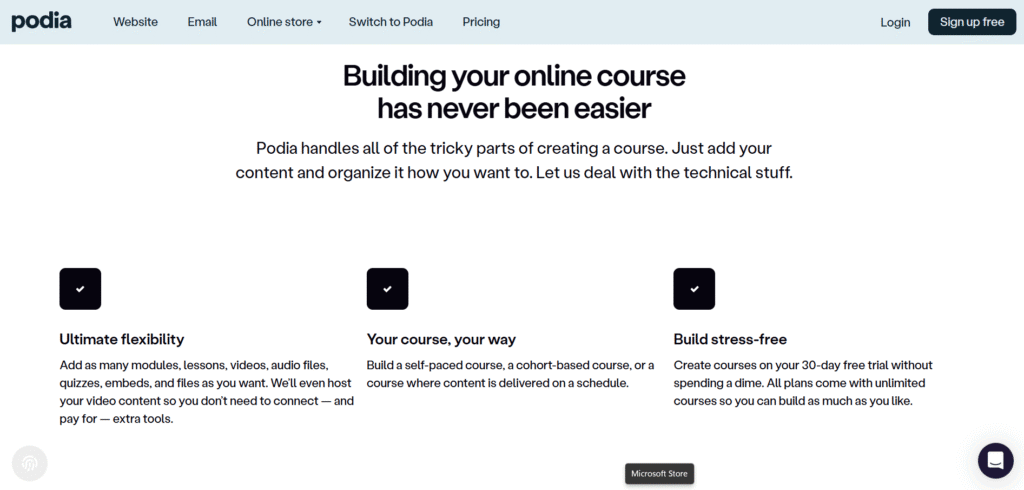
Podia offers a course builder that allows an easy-to-follow system for those who are not tech-savvy. Their design is simplistic and dedicated to letting creators from all fields be able to make full use of their features, especially those who have an online business. They put it all in one place for easy access. You can collect money and give out coupons from their sales page itself. From the presales page, you can contact potential students and send emails to existing ones through the dashboard. The Podia LMS is handy and easy to use.
You can try these out for free for 30 days, after which you will have to purchase a package.
Thinkific Review:
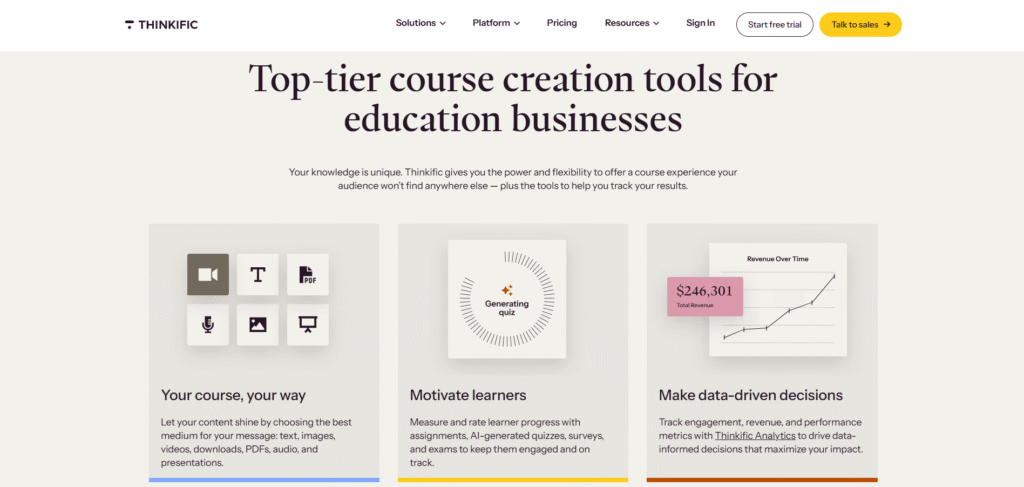
Thinkific allows video conferencing, which Podia does not, giving it a definitive edge over Podia.
Course building is easy. It includes customization options and assumes that you have some knowledge about e-learning structures.
Membership Sites
Is there a membership feature? Only with Podia. Ask your students to subscribe and create a community. Learning is always a two-way street. You can always upgrade your course using their suggestions. Podia offers a straightforward system. It makes membership feel like a breeze. You can add social media channels to a community and extend your engagement beyond the platform.
Marketing and Sales Features
Podia:
Since they do not offer a free plan, some people might feel disheartened. But in fact, Podia gives excellent value for their prices. Even with the cheaper plan, you can email all your students in one go. You get access to a built-in blogging and Podia webinar feature. With better email marketing features (like drip campaigning), you can make a better return on your investment.
Thinkific:
Rather than their email marketing features, you might find yourself relying on Thinkific’s affiliate marketing features more. Create discounts, special one-time offers, and coupon codes while offering instalment payment options as well. This makes sales as easy as drag and drop. Thinkific offers sales widgets, which improve visibility and accessibility to your course for your target audience. With a customized landing page, you can create a brand.
Selling Digital Products
Podia:
Selling physical products is easier on Podia than with its competitor. They have made Podia products readily available and accessible to benefit students to the max. The Podia payment gateways are hassle-free. Any competitor must match some of their requirements. So, it is a definite win or lose for its opposition.
Thinkific:
You can upload files in many more formats than Podia allows. Bundle courses so you can market them all together. This creates a sense of community and coherence in your course content. You can create separate courses for beginners, intermediates, and experts in the field. Unfortunately, that is the extent of Thinkific’s capabilities for selling digital products.
Student Experience and Engagement
Podia:
With Podia courses, you can create basic quizzes to allow your students to test their learning and track their progress. Students can comment on course content, using that space to ask questions and raise doubts. As you respond to these comments, you can help with individual progress and ensure effective learning.
Thinkific
Thinkific, as a Podia alternative, does a much better job with tests and quizzes. Make any kind of landing page that you want. You can create discussion forums, creating a sense of community among your students. This encourages them to keep progressing and share their ideas. They can learn from the analogies and learning tricks that other students use. While this requires minimal effort from the creator, it adds enormous value to the course.
Podia vs. Thinkific Pricing Plans
Thinkific vs Podia: Which one is worth the money?
Podia Pricing:
There are two podia.com pricing package options. The Mover Plan allows you to use most of the features offered by Podia at $39 per month. Create your own storefront, sell digital downloads, host webinars, and use their Podia email marketing features. If you create a good course, this affordable Mover plan will make you profits very soon.
But to take it up a notch, you can go for the Shaker Plan for the Podia cost of $89 per month. What’s the advantage? With just $50 more, you can set up offsite buttons to increase sales, create affiliate marketing codes, and add blogs to your website through the Shaker Plan.
The coolest part about using Podia pricing is that if you upgrade your plan within the first five days of purchase, you get a 15% discount on subsequent purchases for a lifetime! If you buy packages annually, you get two free additional months of membership! Not convinced? Avail yourself of the 30-day free trial and decide for yourself.
Thinkific Pricing:
With their Basic Plan ($49/month), you get basic features like a custom domain, affiliate reporting, and creating coupons, but you must manually register students.
With the Start Plan ($99/month), you can set up a course with another instructor. You can give your students technically assisted assignments, create certificates for them, and create hidden courses! This Start Plan is for instructors who might already have a good reputation.
Now, the Grow Plan ($199/month) truly screams ‘go big or go home.’ If you want a working network of people collaborating, with potentially 50 authors and numerous students, here is the one for you. Suffice it to say, this plan is not for beginners.
Both Thinkific and Podia provide competitive pricing.
What Are the Positives And Negatives of Using Podia?
Positives:
According to Podia reviews, you get brilliant customer support, and they guarantee a no-bot interaction. This means that a real person is at the other end of the chat, capable of empathizing and fruitfully solving your problem. Yes, this means customer support will not be available 24×7, but hands down, your issues will be taken seriously.
With no transaction fees (Shaker Plan), you can withdraw from your earnings whenever you want. From your debut to the finale, you can depend on Podia. They allow you to enroll an infinite number of students, upload as many documents as you want, and access email marketing features with both plans. Sounds beneficial enough. So what’s the catch? Why the big Thinkific vs. Podia showdown?
Negatives:
The biggest one so far: Designed to offer the basics, you cannot customise so well with Podia either. Using visual aids to highlight necessary points will not come as easy to you. There are limited options for what you can do with quizzes. You can’t just drag and drop elements around.
A Better Thinkific Alternative
Pros:
In the Thinkific vs. Podia combat, Thinkific might be all that Podia is not. A very customizable platform and a free plan if you only want to begin investing in your course once it has made a name for itself. Again, no transaction fees to hassle with. The greatest advantage over Podia: you offer your students certificates for work well done. Set compliance standards, create quizzes, and include all learning tools that can take your course from a bundle of material to a skill-building machine.
For customer service, do you prefer email? They got you. Prefer quick calls? They still got you. They have better Zapier integration features. Scaling is much easier with their more expensive packages and custom domain HTML/CSS features. They create student progress reports for you and make your life as an instructor way easier. You can update and improve your course over time with frequent student surveys. Voiceover presentations are simple to put together, and multiple instructors can pitch into course creation on Thinkific. There is another marketing project for your marketing team.
Cons:
Despite vouching for customisation options, Thinkific does not let you link your course to as many digital products as Podia does. Their email marketing features are scarcer than Podia’s. Their memberships are a little costlier, so you might need some convincing. If you gain a lot of students, you will probably be mailing them individually until you buy the more expensive plan.
What Are the Detailed Steps to Creating an Online Course?
Creating an online course is almost equally easy on our two platforms. That’s why we don’t need a Thinkific vs. Podia comparison for this section. Following these easy steps, you will have created an online course most skillfully.
- Learning outcomes: Make a list of the skills you would want your students to develop at the end of the course.
- Content: Convert these skills into objective information. Use analogies and examples, and create quizzes so students can apply and improve their skills.
- Modules: Break down all the information into smaller sections. Make the learning experience easy to keep up with.
- Make it engaging: If someone buys your course, they are interested in what you have to say. Do not ramble on. Give them corporeal information that enriches their knowledge base.
- Resources: Make other resources available. These should include knowledge more basic than given in your course (for people to catch up) and knowledge more advanced (to spark and nurture students’ interests)
Thinkific vs. Podia Conclusion: Who Wins?
A winner cannot be declared without acknowledging that both platforms are unique and serve different interests. Podia is perfect for first-time course creators. Both help you establish a good reputation in the world of e-learning with their host of good marketing features. While Thinkific loses some battles, it wins the war.
Since things come down to student experience, Thinkific wins by a hair for its better engagement features.
Thinkific vs. Podia (FAQs)
Every course is different. What you require for your course might be night and day with the requirements. Maybe you only need to put your content out there. Or maybe the skill you’re selling requires active recall, creative manipulation, and problem-solving.
Depending on the experience you need to create for your course to be valuable to a student, different platforms might be right for you.
Time and again, comparisons between the two show Thinkific emerging victorious. Although Thinkific does not have great marketing features and Teachable does that better, when it comes to customer service, pricing, and course engagement, Thinkific takes the cake.
Teachable is easier to use. It is ideal for entrepreneurs or an online business that want a completely integrated platform that covers all aspects of e-learning courses horizontally. Thinkific, on the other hand, tries to cater to a larger audience and loses some features in doing so. And still, with ample site design opportunities, live lessons, and quizzing features, Thinkific does not fall behind. A Teachable vs. Podia comparison might make more sense since they are simpler platforms. You can check out our other blogs for a Thinkific vs. Teachable vs. Podia battle.
The first and foremost requirement for selling an online course is effective marketing. Any e-learning platform offers you use should come with a toolkit of marketing tools integrated into the course. It should have credibility as well as resourceful packages for tutors.
Many platforms ask for commissions on your earnings. This is alright since they provide a service. But it still is your sweat and effort. Get its worth. Thinkific and Podia are generous in this aspect since they let you keep your earnings.
Also read,
- 7 Best Online Course Platforms
- 7 Best Project Management Software
- Asana Vs Monday: Which Platform is Best for Creators