When preparing for a project management interview, one of the most important things to know is the types of questions that interviewers typically ask.
Companies want to hire project managers who can deliver results, handle risks, manage teams, and control budgets.
To stand out, you must show that you understand both theory and practice.
In this blog, we will cover 21 best project management interview questions often asked in line with the Project Management Institute (PMI) and Royal Institution of Chartered Surveyors (RICS) standards.
These cover project planning, risk management, contracts, leadership, and commercial management.
Every question is thoroughly addressed, along with examples and pointers to help you effectively communicate your answers in an interview.
What is Project Management?
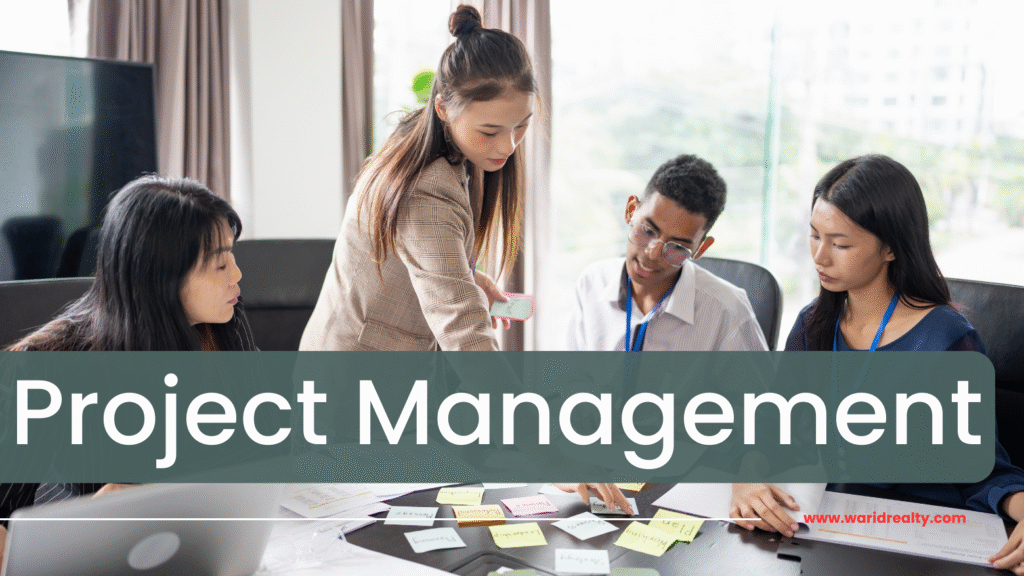
Project management is the application of knowledge, skills, tools, and techniques to deliver a project successfully.
It involves planning, organizing, monitoring, and controlling resources to achieve objectives within time, cost, and quality constraints.
- PMI defines project management through its PMBOK (Project Management Body of Knowledge) framework, which covers five process groups: Initiating, Planning, Executing, Monitoring & Controlling, and Closing.
- RICS emphasizes commercial, contractual, and cost management in construction and real estate projects.
A project manager needs strong leadership, communication, negotiation, and analytical skills.
Whether it is building infrastructure, delivering IT systems, or managing fit-out projects, the principles remain the same: deliver results while managing risks, stakeholders, and resources.
Project Management Interview Questions
Below are 21 detailed project management interview questions with answers.
1. Can you explain the five process groups of the PMBOK and how you applied them in your projects?
The PMBOK process groups are the foundation of project management.
- Initiating – Define the project scope, goals, and stakeholders.
- Planning – Prepare a detailed schedule, budget, and risk management plan.
- Executing – Carry out project activities and coordinate resources.
- Monitoring & Controlling – Track progress, manage risks, and ensure project remains on plan.
- Closing – Finalize deliverables, release resources, and document lessons learned.
I use these steps in every project to maintain structure and discipline. They ensure clarity, reduce risks, and improve stakeholder satisfaction.
Example (brief): In an interior fit-out project, I used these groups to plan schedules, control contractor work, and close with a client handover smoothly.
2. What criteria do you apply to assess project success, and how would you describe it?
Project success is more than just finishing on time and within budget. I measure it through:
- Meeting scope – Delivering what was promised.
- Staying within cost and schedule – Avoiding overruns.
- Stakeholder satisfaction – Clients, users, and teams must be satisfied.
- Quality standards – Deliverables must meet agreed specifications.
- Business value – Project must support organizational goals.
Example (brief): A software project I managed was slightly delayed, but because it improved client efficiency by 20%, it was considered a success.
3. Describe a project where you had to manage risks. How did you identify, assess, and mitigate them?
Risk management is a core responsibility of a project manager. My approach:
- Identify risks – through brainstorming, lessons learned, and expert input.
- Assess risks – rate them based on probability and impact.
- Mitigate risks – develop strategies like avoidance, transfer, mitigation, or acceptance.
- Monitor risks – track them throughout the project.
Example (brief): In a construction project, material price escalation was a risk. I mitigated it by locking prices early through contracts.
4. What project management tools or software have you used?
I use tools depending on project type:
- MS Project / Primavera P6 – scheduling and resource management.
- JIRA / Trello – Agile planning and task tracking.
- Excel – quick analysis, reports, and forecasting.
- Power BI – dashboard reporting.
These tools improve collaboration, visibility, and control.
Example (brief): In a digital rollout project, I used MS Project for schedules and JIRA for sprint tasks, which balanced executive reporting and team flexibility.
5. Tell me about a time when a project did not go as planned. How did you handle it?
Projects often face delays or cost issues. I handle such situations by:
- Identifying the root cause.
- Communicating issues to stakeholders quickly.
- Replanning schedules and reallocating resources.
- Documenting lessons learned for future improvement.
Example (brief): A vendor delayed deliveries by three weeks. I re-sequenced tasks and reduced the final delay to just two weeks.
6. How do you manage communication with multiple stakeholders?
Communication is vital for project success. I prepare a communication plan that defines:
- Who needs information.
- What details they require.
- How it will be delivered (reports, meetings, dashboards).
- When it will be shared (frequency).
I adapt my communication style: executives get high-level updates, while teams get detailed instructions.
Example (brief): In a real estate project, I sent weekly reports to investors, daily updates to site teams, and monthly compliance reports to regulators.
7. What is your leadership style, and how do you motivate your team?
I empower teams, encourage responsibility, and celebrate achievements. Motivation comes from:
- Giving ownership of tasks.
- Recognizing performance.
- Breaking large goals into smaller milestones.
- Maintaining a positive and supportive environment.
Example (brief): In an interior fit-out project, I celebrated weekly wins, which boosted morale and ensured timely delivery.
8. How do you handle scope creep?
Scope creep can derail a project. I handle it by:
- Clearly defining scope at the start.
- Using a formal change control process.
- Performing impact analysis before approving changes.
- Negotiating with stakeholders to move non-critical features to future phases.
Example (brief): In a real estate building project, I accepted only high-priority changes mid-way and shifted the rest to the next release.
9. Explain how you balance time, cost, and quality in project delivery.
The “triple constraint” requires careful trade-offs. I balance by:
- Prioritizing based on stakeholder goals.
- Using risk buffers for time and budget.
- Applying quality checks at each stage.
- Negotiating adjustments when necessary.
Example (brief): In a building project, when faced with tight deadlines, I used overtime shifts but maintained strict quality inspections.
10. What techniques do you use to estimate project costs and schedules accurately?
I use a mix of estimation methods:
- Analogous estimating – based on past projects.
- Parametric estimating – cost per unit (e.g., cost per square foot).
- Bottom-up estimating – detailed work breakdown structure.
- Three-point estimating – optimistic, pessimistic, and most likely values.
Example (brief): In a fit-out project, I used parametric estimates ($/sq.ft.) for budget and bottom-up estimation for detailed work packages.
11. How do you manage change requests during a project’s lifecycle?
I use a structured approach:
- Document the change request.
- Assess its impact on scope, cost, and time.
- Seek stakeholder approval.
- Update the baseline plan if approved.
- Communicate changes to all team members.
Example (brief): In an interior fit-out project, a new compliance requirement was added. I revised the schedule and cost baseline with client approval.
12. What is your experience with Agile, Waterfall, or hybrid methodologies?
- Agile – Best for flexible, iterative projects (IT/software).
- Waterfall – Best for structured projects (construction, manufacturing).
- Hybrid – Combines both for complex projects.
I adapt methodology depending on project type and stakeholder needs.
Example (brief): In a retail expansion project, I used a hybrid model: Agile for store designs and Waterfall for construction.
13. How do you create and manage a project programme or schedule in a construction project?
In construction, scheduling is crucial.
- Break down work using a Work Breakdown Structure (WBS).
- Develop activity sequences.
- Assign resources and durations.
- Identify the critical path.
- Update schedules regularly.
Example (brief): For a commercial tower, I used Primavera P6 to schedule activities and highlight delays early.
14. How have you handled cash flows, cost reporting, and project budgets?
I manage costs by:
- Preparing detailed budgets.
- Tracking actual vs. planned expenditure.
- Updating cash flow forecasts monthly.
- Reporting costs to stakeholders.
Example (brief): In a mall construction, I tracked monthly inflows/outflows, which prevented funding shortages.
15. What contract types are you familiar with, and how have you administered them?
I have worked with:
- Lump sum contracts – fixed price.
- Cost-plus contracts – reimbursable.
- Unit price contracts – cost per unit.
- FIDIC forms – international standards.
I ensure compliance, timely payments, and dispute resolution.
Example (brief): In a highway project, I managed a lump-sum EPC contract by monitoring deliverables against milestones.
16. Describe how you handled a dispute or claim on a project.
Disputes are common. I handle them by:
- Reviewing contract terms.
- Understanding both parties’ concerns.
- Seeking amicable resolution before legal escalation.
- Documenting the resolution process.
Example (brief): In a fit-out project, a subcontractor claimed extra costs. I resolved it by reviewing scope and negotiating partial payment.
17. What is your approach to procurement and supplier selection in construction projects?
I ensure fair and transparent procurement by:
- Preparing tender documents.
- Evaluating bids based on price, quality, and capability.
- Negotiating favorable terms.
- Monitoring supplier performance.
Example (brief): In a corporate office project, I selected suppliers based on both lowest price and track record of timely delivery.
18. How do you ensure compliance with construction technology standards and best practices?
I maintain compliance by:
- Referring to building codes and standards.
- Using quality assurance processes.
- Conducting regular audits.
- Training teams on new technologies.
Example (brief): In a cold storage project, I ensured compliance with energy efficiency standards through inspections.
19. How do you manage health, safety, and sustainability considerations in a project?
I prioritize safety by:
- Preparing a Health & Safety Plan.
- Conducting toolbox talks.
- Monitoring PPE compliance.
- Implementing sustainability practices (waste reduction, energy saving).
Example (brief): On a factory project, strict safety audits reduced incidents to zero over 12 months.
20. Tell me about a time you led a multidisciplinary team on a complex project.
I focus on coordination, communication, and respect for expertise.
- Assign clear roles.
- Hold coordination meetings.
- Encourage collaboration between engineers, architects, and contractors.
Example (brief): In a hospital project, I led architects, structural engineers, and contractors, ensuring smooth coordination for timely delivery.
21. What commercial management techniques do you use to control costs and protect project value?
Commercial management protects profitability. I use:
- Earned Value Management (EVM) – to track cost and schedule.
- Cash flow forecasting – to prevent shortages.
- Value engineering – to optimize costs without reducing quality.
- Regular cost reporting – for transparency.
Example (brief): In a shopping center project, I used EVM to highlight overspending early and corrected it before major loss.
Conclusion (Project Management Interview Questions)
Interviewing for a project management position involves clearly demonstrating both technical and interpersonal strengths.
PMI-aligned questions focus on PMBOK knowledge, methodologies, risk and quality management, and communication.
RICS interviews dig into practical competencies like cost control, contract adherence, planning, and behavioral leadership examples.
To prepare:
- Use the STAR approach (Situation, Task, Action, Result) to organize your stories.
- Incorporate tools like RAID logs, risk matrices, fishbone diagrams, and CPM techniques
- Tie your experience to the relevant standards—PMBOK frameworks (initiating through closing) or RICS competencies (commercial management, contract practice)
- Show engagement by asking meaningful questions in return
When you speak confidently and clearly about real examples, you stand out as a grounded, capable project manager.
Also read, principles of project management.