The principles of project management act as guiding lights that help teams deliver successful projects. They provide structure, discipline, and direction in an environment where deadlines are tight, budgets are limited, and expectations are high.
Without these principles, projects often drift off course, resulting in delays, increased costs, or dissatisfied stakeholders.
Project managers and teams can enhance their chances of completing projects on schedule, within budget, and with significant results by adhering to effective management principles.
In today’s fast-paced world, organizations rely heavily on projects to drive growth and innovation. Whether it’s constructing a metro line, launching a mobile app, or planning a cultural festival, every project demands a clear roadmap.
Project management offers that roadmap, but it is the principles that make it reliable. These principles emphasize responsibility, leadership, adaptability, quality, and value creation.
These are adaptable strategies that work in a variety of settings and cultures rather than strict regulations.
This blog explores the meaning of project management and explains each of the 12 Principles of Project Management introduced by the Project Management Institute (PMI).
Key Takeaways
- Project management principles guide teams to deliver successful projects by providing structure and clarity.
- These principles emphasize responsibility, leadership, and adaptability, essential for navigating challenges.
- The article outlines 12 key principles, including stewardship, teamwork, and risk management.
- Focusing on value and quality ensures projects meet stakeholders’ needs and expectations.
- Applying these principles can lead to timely and effective project results across various industries.
What is Project Management?

To understand project management, let us first answer a basic question: What is a project?
A project is a temporary endeavor undertaken to create a unique product, service, or result. It has a clear start and end date, specific goals, and usually involves several people working together.
Examples of projects:
- Building a new airport terminal
- Designing a mobile application
- Organizing an international sports event
- Setting up a solar power plant
Each project is unique. Even if two shopping malls look alike, the challenges of construction, location, labor, and budget will differ.
Now, project management is the practice of guiding this temporary effort to success. It involves:
- Planning the work clearly.
- Organizing resources like money, people, and materials.
- Executing tasks to achieve results.
- Monitoring and controlling progress to avoid delays or overruns.
- Closing the project properly once goals are achieved.
In short, project management makes sure that a project delivers what it promised, within the planned time, budget, and quality standards.
12 Principles of Project Management

Let’s dive deeper into the principles that guide successful projects.
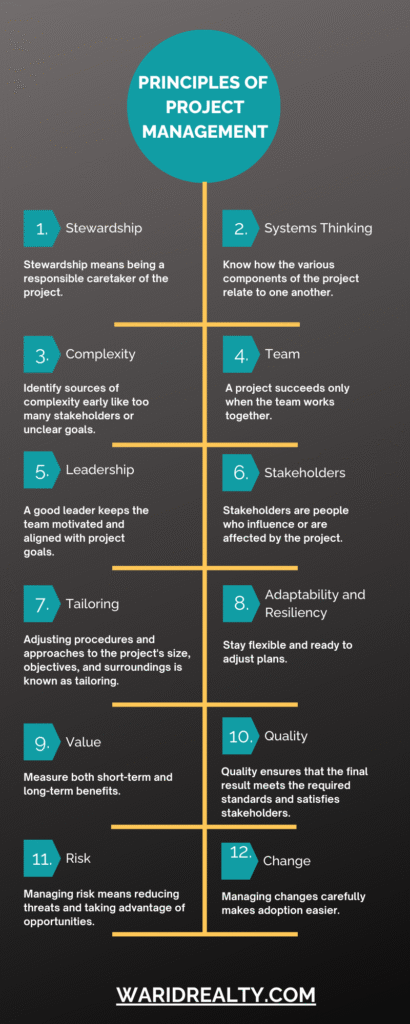
1. Stewardship
Stewardship means being a responsible caretaker of the project. A project manager does not own the resources but is entrusted with them.
- Act with integrity and fairness in every decision.
- Take responsibility for outcomes, whether they succeed or fail.
- Balance financial results with social and environmental impacts.
Example: In a real estate project, stewardship means ensuring construction workers are safe, materials are used wisely, and legal rules are followed.
2. Systems Thinking
Projects are part of larger systems. They interact with organizations, communities, technologies, and environments. A manager must see the whole picture, not just one task.
- Know how the various components of the project relate to one another.
- Consider external factors such as policies, regulations, or culture.
- Adjust decisions to align with the wider system.
Example: A metro rail project is not just about laying tracks. It must also consider urbantraffic, city planning, environmental impact, and passenger needs.
3. Complexity
Most projects are complex. They involve multiple people, changing technologies, and unpredictable events. Handling complexity requires planning and flexibility.
- Identify sources of complexity early-like too many stakeholders or unclear goals.
- Break complex tasks into smaller, manageable steps.
- Stay flexible and ready to adapt when things get complicated.
Example: Upgrading a hospital’s IT system is complex because different departments use different technologies. Careful planning ensures smooth integration.
4. Team
A project succeeds only when the team works together. Tools and processes matter, but people matter more.
- Create a culture of trust and collaboration.
- Encourage open communication and feedback.
- Support team members in learning and growing.
Example: In an interior design project, architects, engineers, and contractors must cooperate closely. Without teamwork, deadlines will be missed.
5. Leadership
Leadership is more than just issuing commands; it’s also about motivating and directing others. A good leader keeps the team motivated and aligned with project goals.
- Adapt leadership style to suit the situation.
- Lead by example with honesty and transparency.
- Encourage team members to take responsibility.
Example: A project manager handling a remote IT team during COVID-19 needed empathy, regular communication, and flexibility to keep morale high.
6. Stakeholders
Stakeholders are people who influence or are affected by the project. Managing them well prevents conflicts and ensures smoother progress.
- Identify all stakeholders early.
- Keep them informed with clear and timely communication.
- Balance different expectations fairly.
Example: In a housing project, buyers, contractors, banks, and government bodies are stakeholders. Ignoring even one group can cause serious delays.
7. Tailoring
No two projects are the same. Adjusting procedures and approaches to the project’s size, objectives, and surroundings is known as tailoring. Avoid using the same rigid process everywhere.
- Apply “just enough” documentation and reporting.
- Continuously refine methods as the project evolves.
Example: A small community project doesn’t need the same level of reports and approvals as a billion-dollar airport project.
8. Adaptability and Resiliency
Change is constant. Projects often face unexpected challenges. Adaptable and resilient teams handle these situations better.
- Stay flexible and ready to adjust plans.
- Focus on achieving outcomes even when conditions shift.
- Build resilience by preparing for setbacks.
Example: During a supply chain crisis, a construction project manager found alternative local suppliers instead of waiting for imports.
9. Value
Projects are not just about delivering outputs; they must deliver value. Value means the real benefit created for the customer, organization, or society.
- Ask, “What problem does this project solve?”
- Measure both short-term and long-term benefits.
- Maximize value even if it means changing the approach.
Example: A solar project delivers value by cutting electricity bills and reducing pollution, not just by installing panels.
10. Quality
Quality ensures that the final result meets the required standards and satisfies stakeholders. Poor quality can damage trust and increase costs later.
- Define clear quality standards early.
- Monitor results at every stage of the project.
- Deliver outcomes that are reliable and useful.
Example: For a highway project, quality means smooth roads, proper drainage, and durability-not just completion.
11. Risk
Uncertainty is part of every project. Managing risk means reducing threats and taking advantage of opportunities.
- Identify risks regularly.
- Develop plans to respond to both problems and opportunities.
- Assign responsibility for managing each risk.
Example: A real estate developer may face risk from rising steel prices. Fixing prices early with suppliers can protect the budget.
12. Change
Projects bring change to organizations, communities, and people. Managing this transition carefully makes adoption easier.
- Prepare people for changes in systems or processes.
- Offer training and support to reduce resistance.
- Explain clearly why the change is necessary.
Example: When a company introduces new project management software, managers must guide employees through the transition to prevent resistance.
Conclusion (Project Management Principles)
The 12 Principles of Project Management act as a compass for teams navigating today’s complex projects. They focus on responsibility, teamwork, adaptability, value, and leadership. Unlike rigid rules, these principles are flexible enough to apply to any industry or project.
By practicing stewardship, managing stakeholders, handling risks, and leading with integrity, project managers can deliver not just outputs but meaningful results. These principles ensure that projects finish on time, within budget, and with long-term benefits for stakeholders and society.
In a world where change is constant, applying these principles helps professionals move from uncertainty to confidence, and from failure to sustainable success.
Project Management Principles FAQ
In contrast to operations, which are continuous and repetitive, a project is transient and unique.
They guide project managers in making the right choices, ensuring that projects stay on track and deliver value.
Yes. They are flexible and work for projects of all sizes.
Good leadership keeps teams motivated, resolves conflicts quickly, and ensures alignment with goals.
Value is the real benefit a project creates—such as efficiency, profit, or social impact—not just the deliverable.
Also read,
- Objectives of Project Management: PMI
- Project Life Cycle: Phases of Project
- Certified Associate in Project Management (CAPM) Guide
5 thoughts on “Principles of Project Management PMI 2026”