
Project management objectives are the guiding force behind every successful project. They provide direction, create focus, and ensure that all efforts move toward a common goal.
Without clear objectives, projects often face delays, cost overruns, poor quality, and stakeholder dissatisfaction. By defining objectives such as timely delivery, cost control, quality assurance, and risk management, project managers create a roadmap that keeps the team on track.
Whether it is a construction project, software development, healthcare initiative, or an event, project management objectives help achieve results that add value to both clients and organizations.
Estimated reading time: 6 minutes
Key Takeaways
- Project management objectives guide projects toward success by providing direction and focus.
- Key objectives include delivering projects on time, controlling costs, meeting quality standards, and managing risks effectively.
- Ensuring stakeholder satisfaction and optimizing resource use also play critical roles in achieving project management objectives.
- Defining clear project scopes and promoting teamwork enhances project execution and efficiency.
- Ultimately, effective project management objectives create business value and contribute to long-term organizational growth.
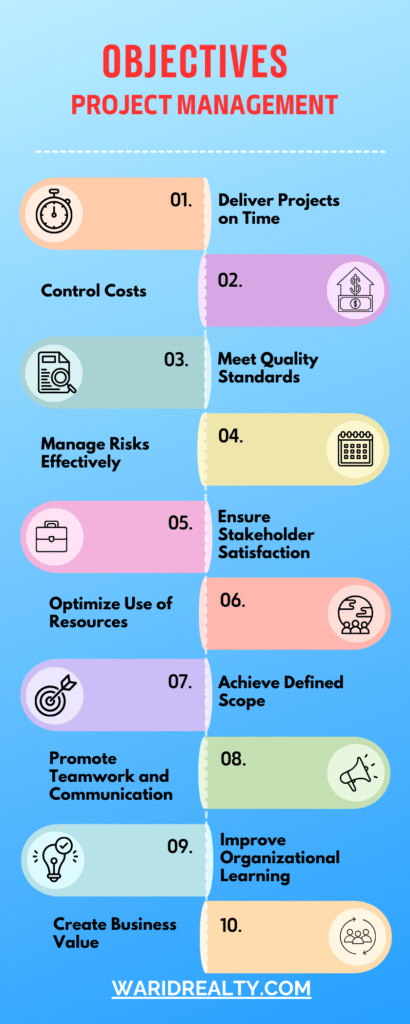
Project management objectives

1. Deliver Projects on Time
One of the primary objectives of project management is to complete the project within the planned timeline. Deadlines matter because delays can cause financial losses and reduce client trust.
Project managers break down work into smaller tasks, assign responsibilities, and monitor progress regularly.
They use tools like Gantt charts and scheduling software like Primavera P6, Microsoft Project, to track deadlines. By keeping activities aligned with the schedule, they ensure that the project finishes on time, which improves efficiency and client satisfaction.
2. Control Costs
Another major objective is cost control. Projects come with limited budgets, and overspending can reduce profits or even stop the project midway.
Project managers and cost consultants estimate costs before the project begins and monitor spending during execution. They compare planned budgets with actual expenses using earned value analysis to correct any deviations.
Effective cost control allows organizations to use their funds wisely and deliver projects profitably.
3. Meet Quality Standards
A project that finishes on time and within budget still fails if it does not meet quality standards. Clients expect outputs that match agreed specifications and requirements.
Project managers set quality benchmarks at the start and ensure that all deliverables meet those benchmarks. They conduct inspections, tests, and reviews to maintain quality throughout the project.
Meeting quality standards not only satisfies clients but also enhances the reputation of the organization.
4. Manage Risks Effectively
Every project faces risks such as material shortages, design errors, technical failures, or unexpected delays. If these risks are ignored, they can lead to project failure.
The objective here is to identify risks early, assess their potential impact, and prepare strategies to reduce them.
Project managers create risk registers, conduct impact analysis, and prepare contingency plans. By managing risks effectively, they improve project stability and reduce uncertainty.
5. Ensure Stakeholder Satisfaction
Stakeholders include clients, investors, suppliers, and team members who are directly or indirectly involved in the project. Keeping them satisfied is an important objective of project management.
Project managers communicate regularly with stakeholders, provide progress updates, and involve them in decision-making. Stakeholders actively support a project when they feel appreciated and educated.
Satisfied stakeholders reduce conflicts and contribute to smoother project execution.
6. Optimize Use of Resources
Projects require resources such as manpower, machinery, money, and materials. If these resources are wasted or misused, the project may fail.
One of the project management objectives is to use resources effectively. Project managers allocate work according to skills, balance workloads, and monitor material usage. Efficient use of resources saves money, reduces delays, and improves productivity.
7. Achieve Defined Scope
The scope of a project defines what needs to be delivered. If the scope is unclear or keeps changing without approval (known as scope creep), it causes confusion and delays.
Project managers clearly define the scope during planning and ensure that all work aligns with it. Any changes go through formal approval processes. This control helps the project stay focused and achieve its original goals without unnecessary additions.
8. Promote Teamwork and Communication
Projects involve people from different departments and backgrounds. Without strong teamwork and communication, misunderstandings and conflicts are likely.
Project managers encourage open communication, hold regular meetings, and use collaboration tools to keep the team connected. They also promote a culture of trust and cooperation. Good teamwork increases efficiency, reduces errors, and creates a positive work environment.
9. Improve Organizational Learning
Every project provides lessons that can help future projects. Recording these lessons is another key objective of project management.
At the end of a project, managers conduct reviews to identify strengths and weaknesses. They document the findings and share them within the organization. This learning process improves project strategies, reduces repeated mistakes, and strengthens the organization over time.
10. Create Business Value
Project management’s ultimate goal is to add value for the company and its customers. Projects should not only finish successfully but also contribute to long-term growth.
Business value may come in the form of profits, customer satisfaction, efficiency, or innovation. Project managers align project goals with organizational strategies to ensure meaningful outcomes. Successful projects enhance reputation and give the organization a competitive advantage.
What Types of Project Management Exist?
Different industries and organizations use different types of project management methods. Some common types are:
- Waterfall Project Management – a methodical technique where each stage is finished before going on to the next. Suitable for construction and manufacturing.
- Agile Project Management – Flexible and iterative, often used in IT and software development.
- Scrum – A type of Agile approach that uses short cycles (sprints) to complete tasks quickly.
- Kanban – A visual method of managing tasks using boards and cards to track progress.
- Lean Project Management – Focuses on reducing waste and improving efficiency.
- Hybrid Approach – A mix of traditional and modern methods, adapted to project needs.
Who Uses Project Management?
Project management is used by a wide range of professionals and organizations, including:
- Construction companies – to manage building, interior fit-outs, and infrastructure projects.
- IT and software firms – to develop and deliver software solutions on time.
- Healthcare organizations – to implement new systems or build facilities.
- Government agencies – to execute public projects like roads, housing, and urban development.
- Event planners – to organize large events, conferences, or exhibitions.
- Startups and businesses – to launch new products and services.
In short, anyone who needs to complete a project in a structured way benefits from project management.
Conclusion (Project management objectives)
Project management objectives are the foundation of every successful project. They ensure that time, cost, quality, and resources are managed effectively while risks are minimized and stakeholders remain satisfied.
By focusing on these objectives, project managers turn plans into results and deliver real value to organizations. Whether it is a small assignment or a large infrastructure project, clear objectives make the difference between success and failure. Also read Principles of Project Management.
Objectives of Project Management FAQs
They guide the project, keep it focused, and ensure successful completion.
They ensure risks are identified, analyzed, and controlled before they cause problems.
MS Project, Primavera, Trello, Asana, and Jira are commonly used tools for scheduling and tracking.
Also read,
- Project Life Cycle: Phases of Project Guide 2026
- Project Management Professional Certification Overview
- Certified Associate in Project Management (CAPM) Guide
3 thoughts on “Objectives of Project Management 2026”