

As an aspiring project manager, you may already work on complex projects, manage deadlines, coordinate teams, and communicate with stakeholders. However, you may still feel that your experience does not receive the recognition it deserves. In a competitive job market, experience alone is often not enough. This is where the Project Management Professional Certification (PMP) becomes extremely important.
The Project Management Professional Certification, commonly known as PMP, is one of the most respected credentials in the field of project management. It validates your ability to lead projects, manage people, control risks, and deliver results in real business environments.
Employers across industries trust PMP-certified professionals because the certification follows global standards and focuses on practical project management skills.
The Project Management Professional Certification offers structure and direction. It helps you develop a professional mindset, improve decision-making, and align project work with organisational goals.
PMP is not just about passing an exam. It is about becoming a confident, capable, and value-driven project manager prepared for long-term career growth.
Estimated reading time: 8 minutes
Key Takeaways
- The Project Management Professional Certification (PMP) is a prestigious credential that validates leaders in project management.
- To qualify for PMP, candidates must meet educational and experience criteria set by the Project Management Institute (PMI).
- The PMP exam consists of 180 questions and evaluates skills in managing people, processes, and business environments.
- Achieving PMP certification enhances career opportunities, global recognition, and potential salary increases.
- Maintaining PMP certification requires earning 60 Professional Development Units (PDUs) every three years to stay updated in the field.
Project Management Professional Certification: Eligibility Requirements
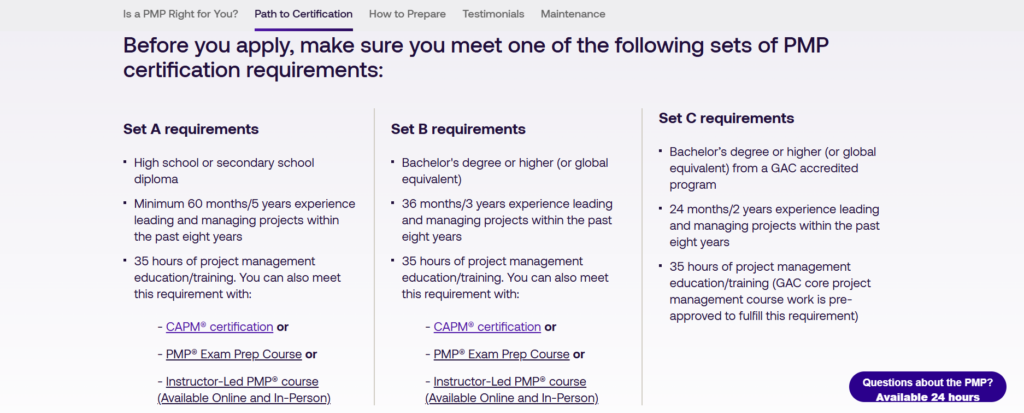
To apply for the Project Management Professional Certification, you must meet the eligibility criteria defined by the Project Management Institute (PMI).
These requirements ensure that every PMP-certified professional has both formal education and real-world project leadership experience.
According to the PMP Examination Content Outline (January 2021), all project management experience must be gained within the last eight consecutive years before submitting the application.
PMI offers three eligibility paths based on educational background. If you hold a secondary degree such as a diploma or associate degree, you need a minimum of 60 months of unique, non-overlapping professional project management experience.
If you hold a four-year bachelor’s degree or equivalent, you need at least 36 months of such experience.
Candidates with a bachelor’s or postgraduate degree from a GAC-accredited program require only 24 months of experience.
In all cases, the experience must include leading and directing projects, not just supporting tasks. In addition to experience, candidates must complete 35 contact hours of formal project management education, unless they hold an active CAPM certification, in which case this requirement is waived.
The PMP Certification Exam: Format and Content
The PMP Certification exam is designed to measure how effectively a professional can lead and direct projects in real-world environments.
According to the PMP Examination Content Outline (January 2021) published by the Project Management Institute, the exam consists of 180 questions, out of which 175 questions are scored and 5 are unscored pretest questions.
These pretest questions do not affect the final score and are used by PMI to validate future exam content. The total exam duration is 230 minutes, and the exam includes two optional 10-minute breaks, which appear after completing questions 1–60 and 61–120. Once you begin a break, you cannot return to the previous set of questions.
The exam content is structured around three domains that reflect the responsibilities of modern project managers.
- The People domain accounts for 42% of the exam and focuses on leadership skills such as conflict management, team motivation, stakeholder engagement, and emotional intelligence.
- The Process domain, which carries the highest weight at 50%, covers core project management activities including scope, schedule, cost, quality, risk, procurement, change management, and project closure.
- The Business Environment domain represents 8% of the exam and evaluates how well a project manager aligns projects with organizational strategy, compliance requirements, and external business changes.
The PMP exam also reflects the reality that projects operate in different delivery environments.
About half of the exam questions are based on predictive approaches, while the remaining questions focus on agile and hybrid approaches.
These approaches are integrated across all three domains rather than tested separately. The exam uses multiple question formats such as multiple-choice, multiple-response, matching, and hotspot questions.
This structure ensures that the PMP Certification exam evaluates practical decision-making, leadership judgment, and adaptability rather than rote memorization
Benefits of Obtaining Project Management Professional Certification
The Project Management Professional Certification offers strong benefits for aspirants. One of the biggest advantages is global recognition. PMP is respected across countries and industries, which immediately enhances professional credibility.
The certification also improves career opportunities. Many organizations prefer or require PMP-certified professionals for leadership roles such as Project Manager, Program Manager, PMO professional, or Project Controls Manager. PMP-certified professionals often earn higher salaries because employers value their ability to manage risks, budgets, and teams effectively.
The Project Management Professional Certification also strengthens practical skills. It improves planning ability, communication, problem-solving, and decision-making. Another important benefit is industry flexibility. PMP principles apply across construction, IT, manufacturing, healthcare, real estate, and consulting. This makes PMP a long-term career asset.
How to Maintain Your Project Management Professional Certification
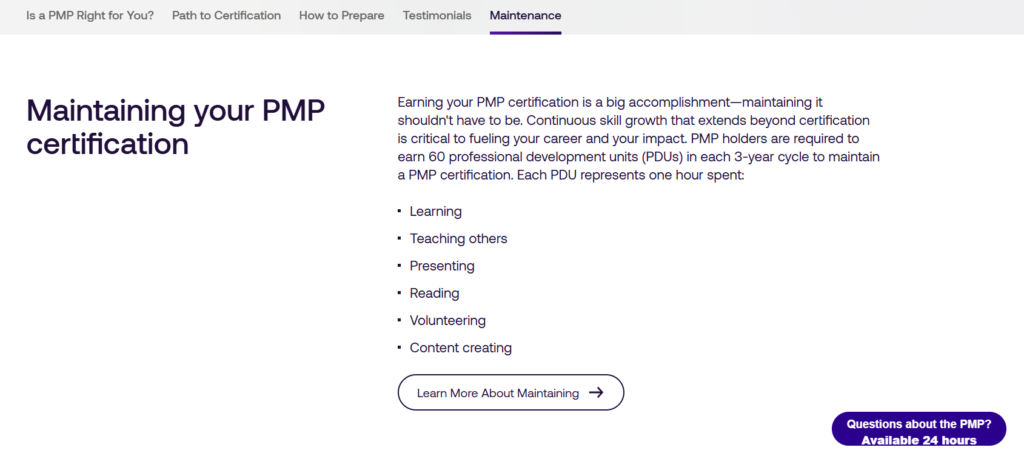
The Project Management Professional Certification remains valid for three years. To maintain it, PMI requires continuous professional development. You must earn 60 Professional Development Units (PDUs) during each three-year cycle.
PDUs fall into two categories. Education PDUs focus on technical project management, leadership, and strategic business skills. Giving Back PDUs include activities such as working as a project manager, mentoring, volunteering, or creating project management content. This flexible system allows professionals to maintain certification without unnecessary pressure.
The renewal process is simple. You record your PDUs in PMI’s online system, submit the renewal application, and pay the renewal fee. Regular learning keeps your certification active and your skills relevant.
How PMP Exam Reflects Real Project Challenges
The PMP exam reflects real project challenges by focusing on practical situations instead of theoretical definitions. The exam presents scenarios that mirror daily project issues such as tight deadlines, limited resources, scope changes, and stakeholder conflicts. As an aspirant, you must analyze each situation and select the best action a project manager should take.
The exam places strong emphasis on people management. Many questions test how you handle team conflicts, motivate team members, support collaboration, and communicate effectively with stakeholders. This reflects real projects, where leadership and communication often determine success.
Risk and change management also play a major role. The PMP exam includes situations where risks occur unexpectedly or priorities change mid-project.
You must respond proactively while protecting project objectives. The inclusion of agile and hybrid scenarios further shows how modern projects demand flexibility. Overall, the PMP exam prepares you to face real project challenges with confidence and clarity.
Conclusion: Is Project Management Professional Certification Right for You?

The Project Management Professional Certification is a serious but rewarding commitment. It is ideal for professionals who already work on projects and want global recognition for their skills. PMP strengthens leadership abilities, improves decision-making, and aligns project work with business goals.
However, the Project Management Professional Certification requires discipline, effort, and continuous learning. It is not a shortcut to success. If you enjoy planning work, leading teams, managing risks, and delivering results under constraints, PMP fits your career goals well.
For aspirants seeking senior roles, international exposure, or higher earning potential, the Project Management Professional Certification offers lasting value. More importantly, it helps you grow into a confident, adaptable, and value-driven project manager ready for future challenges.
Project Management Professional Certification (FAQs)
The PMP exam contains 180 questions in total. Out of these, 175 questions are scored, and 5 are unscored pretest questions. PMI uses pretest questions to evaluate future exam content, but they do not affect your final result.
Yes, the PMP exam strongly includes agile and hybrid approaches. About half of the exam questions are based on agile or hybrid environments. These approaches appear across all domains and reflect how modern projects operate today.
The PMP certification is valid for three years. To maintain it, you must earn 60 Professional Development Units (PDUs) during each cycle and complete the renewal process before the certification expiration date.
PDUs are learning and professional activities required to maintain PMP certification. They include education in technical, leadership, and business skills, as well as giving-back activities such as working as a project manager or mentoring others.
Also read,
- Certified Associate in Project Management (CAPM) Guide 2026
- Project Management Interview Questions: 21 PMI and RICS
- Principles of Project Management: Simplified 2026



2 thoughts on “Project Management Professional Certification Overview 2026”