
One of the safest and most dependable paths to wealth and financial security is real estate investing.
It has always been seen as a safe investment because land and property are physical assets that hold value over time.
Unlike stocks or other financial products, real estate is generally less volatile and tends to appreciate in value with population growth, urban development, and rising demand.
However, property value does not improve without certain factors.. Many factors decide whether a property becomes more valuable or not.
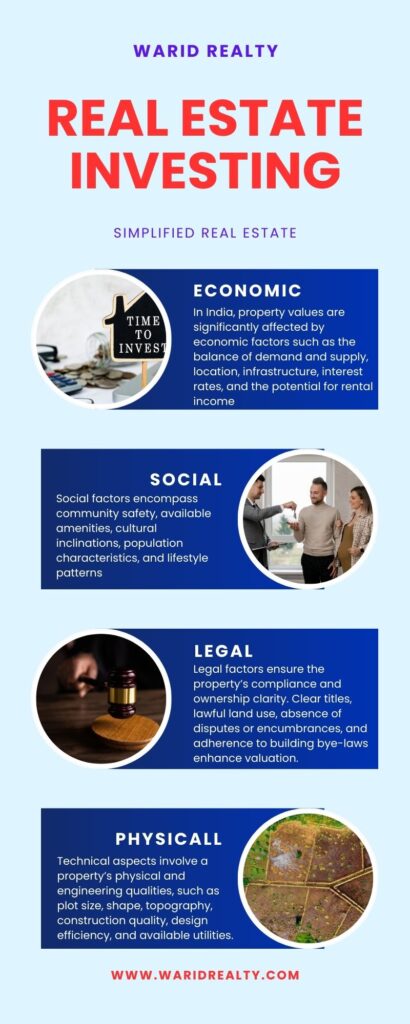
These factors are usually divided into four main groups: economic, physical, social, and legal.
Understanding them is very important for anyone planning to invest in real estate.
Estimated reading time: 8 minutes
Key Takeaways
- Real estate investing is a dependable path to wealth due to its stability and long-term value appreciation.
- Key factors influencing property values include economic conditions, physical features, social aspects, and legal clarity.
- Real estate provides unique benefits like wealth creation, inflation protection, and generational security.
- Investors should analyze four main groups of factors to make informed decisions in real estate investing.
- In a growing society with increasing demand, real estate remains one of the best investment options for financial stability.
Why Real Estate Investing is Important
After looking at all the factors, one important question comes forward: why should anyone consider real estate investing in the first place?
The answer lies in its unique benefits.
- Wealth Creation – Real estate is one of the few investments that grows steadily in value over time while also providing rental income.
- Stability Compared to Other Assets – Stock markets and gold may fluctuate quickly, but property values usually rise gradually and remain stable in the long run.
- Tangible and Useful Asset – Property is something that can be used, lived in, or rented out. Unlike shares or bonds, it is a physical asset that gives direct utility.
- Generational Security – Real estate is often passed on to children and grandchildren, becoming a family asset for decades.
- Protection Against Inflation – As the cost of living rises, property values also rise. This protects money from losing its purchasing power.
- Growing Urban Demand – With rapid urbanization in India and other developing nations, the demand for housing, commercial spaces, and industrial land will only increase. This makes real estate investing a strong long-term choice.
Economic Factors in Real Estate Value
The most powerful driver of property value is the economy. Real estate is deeply connected to the financial condition of a country, city, or even a small locality.
- Employment and Business Growth – Areas where industries, offices, or business hubs are developed always attract more people. When employment opportunities grow, the need for housing rises, leading to higher property prices. For example, IT hubs like Bengaluru or Hyderabad have seen property values increase mainly due to employment growth.
- Income Levels – When people earn more, they are able to afford bigger and better homes. This demand for quality housing leads to higher values. Rising incomes in urban India have created more interest in apartments, gated communities, and luxury homes.
- Interest Rates on Loans – Real estate purchasing is often done through home loans. When interest rates are low, more people buy property, which increases demand and raises prices. When interest rates are high, property demand usually slows down.
- Inflation and Construction Costs – When inflation rises, the prices of materials such as cement, steel, and labor also rise. This raises the cost of construction and ultimately increases property prices. The price of land also increases with inflation.
- General Economic Growth – A growing economy always leads to stronger real estate demand. Cities with high GDP growth usually experience a rise in property values, while areas with poor economic activity often face stagnant or falling property prices.
Physical Factors in Real Estate Value
Physical characteristics of land and property are another major influence on value. These are visible and practical features that buyers consider before making decisions.
- Location – The old saying “location, location, location” is still true. A property located near markets, offices, schools, hospitals, or transport facilities will always be valued more than one in an isolated or poorly connected area.
- Infrastructure – Roads, highways, electricity, water supply, drainage, and public transport strongly influence property value. A house in an area with good infrastructure is naturally more desirable.
- Climate and Environment – Properties in clean, green, and pollution-free areas with a pleasant climate usually get higher demand. On the other hand, areas affected by pollution, noise, or frequent flooding often see lower values.
- Topography and Land Quality – Flat land is easier and cheaper to build upon compared to hilly or rocky land. Similarly, fertile agricultural land may attract more value than barren land in rural areas.
- Condition of Building – A well-maintained building with modern design and facilities is always valued higher than an old or neglected property. Renovation and upkeep add directly to the property’s worth.
Social Factors in Real Estate Value
Social conditions also play an important role in deciding property values. These factors relate to people, communities, and lifestyle needs.
- Population Growth – When the population increases in a city or locality, demand for housing automatically rises. Limited supply combined with higher demand leads to rising property values.
- Lifestyle Changes – Modern families often look for facilities like gyms, clubhouses, Wi-Fi, and parking spaces. Properties that meet these preferences enjoy higher demand.
- Education and Healthcare Facilities – Areas with good schools, colleges, and hospitals always attract families. Plots near reputed institutions directly add to property value.
- Safety and Security – Crime-free neighborhoods with good law and order are always more desirable. People are ready to spend more for secure neighborhoods and gated developments.
- Community and Image of Locality – A well-planned township or a respected neighborhood creates social prestige. Such areas become high-value zones compared to neglected or poorly managed localities.
- Recreational and Cultural Amenities – Parks, shopping malls, theatres, and sports facilities make life more comfortable. Properties in such areas enjoy better demand and higher prices.
Legal Factors in Real Estate Value
Legal aspects are often the most overlooked but are among the most critical in determining property value.
A property with legal issues may lose its entire value, no matter how good its location or physical features are.
- Clear Ownership and Title – Buyers always look for clean ownership records. If ownership is disputed or unclear, property value falls sharply. A clear title deed is essential.
- Land Use and Zoning Laws – Governments regulate how land can be used. Residential land, commercial land, agricultural land, and industrial land all have different rules. If the land use is not legally approved, property value gets reduced.
- Approvals and Permissions – Buildings must follow municipal and government rules. Unauthorized constructions may face demolition or fines, which reduces value. Legally approved projects always command higher prices.
- Property Taxes and Charges – Tax rates, registration fees, and stamp duties affect both buyers and sellers. If these charges are too high, demand may reduce, affecting prices.
- Leasehold vs Freehold Property – Freehold land provides complete ownership, while leasehold limits ownership to a certain period. Naturally, the market considers freehold properties more valuable.
Legal clarity ensures confidence in buyers and investors. Without it, a property may lose its attractiveness even if other factors are favorable.
Real Estate Investing Conclusion
Real estate investing is not just about buying and selling property. It is about understanding the forces that create value.
Economic growth, physical features, social needs, and legal rules influence property values, these are also the aspects of valuation. Each of these factors must be studied before making an investment.
Economic strength creates demand, physical features improve attractiveness, social conditions build desirability, and legal security protects ownership.
Together, they decide whether a property grows in value or becomes a risky investment.
Real estate offers investors opportunities for building wealth, ensuring stability, and achieving long-term security.
It is one of the most reliable forms of investment because it is both practical and valuable. By carefully analyzing the four key factors, individuals can make smart decisions, reduce risks, and maximize benefits in real estate investing
Real estate investing continues to remain important because land and property are limited, while human needs are unlimited.
As cities grow and societies change, property values will keep rising where demand and security are strong.
For anyone planning financial stability and long-term growth, real estate remains one of the best investments to consider.
Real Estate Investment (FAQs)
Real estate investing means buying property such as land, houses, apartments, or commercial spaces with the aim of earning profit. Profit can come through rental income, resale at higher prices, or long-term value appreciation.
Real estate is a physical asset that generally grows in value over time. Unlike stocks, it does not fluctuate daily. It also provides both use (living, renting) and wealth creation, which makes it safer and more stable.
The main factors are economic growth (jobs, income, loans), physical features (location, infrastructure, condition), social aspects (population, lifestyle, safety), and legal clarity (ownership, approvals, zoning).
Yes. Inflation increases the cost of materials and labor, which raises construction expenses. Land values also rise with inflation, leading to higher property prices.
Also read,
- Property Management Guide: 2026
- Top Real Estate Agencies in Dubai: For Your Dream Home
- Real Estate Investment Trust (REIT): Guide 2026
- Real Estate Agent Salary: Unlocking Earnings 2026